
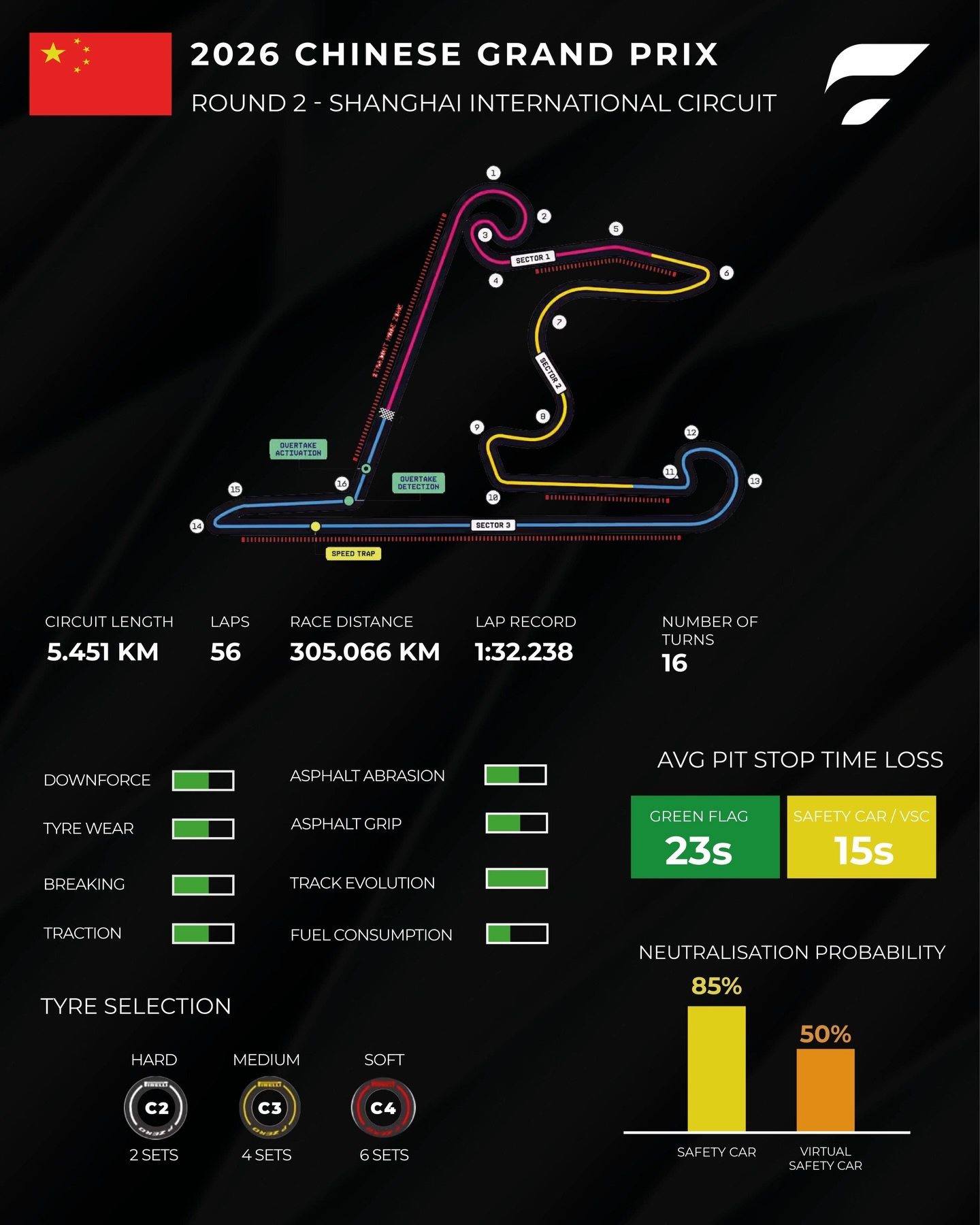
The primary keyphrase “track infos of the Chinese Grand Prix” takes center stage as racing enthusiasts turn their attention to the Shanghai International Circuit. This highly anticipated event brings a wealth of data for fans to analyze, from circuit length and lap records to tyre selection and pit stop strategies.
Key Track Infos of the Chinese Grand Prix
The Shanghai International Circuit is set to host Round 2 of the 2026 season, offering a challenging layout with 16 turns spread across a 5.451 km track. Competitors will complete 56 laps, covering a total race distance of 305.066 km. The lap record stands at an impressive 1:32.238, reflecting the speed and precision demanded by this circuit.
Among the most notable secondary phrases are “circuit length,” “race distance,” “lap record,” and “number of turns.” Each element shapes the strategy teams must adopt as they navigate the technical corners and lengthy straights that define this venue.
Tyre Selection and Strategic Insights
Tyre management remains critical at the Chinese Grand Prix. Teams can choose between hard (C2), medium (C3), and soft (C4) compounds, with an allocation of two sets of hard, four sets of medium, and six sets of soft tyres. The balance between tyre wear, asphalt grip, and track evolution is crucial for optimizing performance throughout the race.
Downforce, braking, traction, and fuel consumption all play significant roles in shaping race strategies. The circuit’s characteristics demand careful attention to these factors, as well as consideration for asphalt abrasion and grip levels that may evolve during the event.
Pit Stops and Safety Car Probabilities
Pit stop timing can be a game-changer at Shanghai. Under green flag conditions, the average pit stop time loss is 23 seconds, while under safety car or virtual safety car scenarios, it drops to just 15 seconds. Teams must remain adaptable as safety car deployment is statistically likely—there’s an 85% probability for a full safety car and a 50% chance for a virtual safety car period.
With overtaking zones clearly marked and a dedicated speed trap on the circuit map, drivers have strategic opportunities to make bold moves. Every aspect of these track infos—from tyre selection to pit stop timing—contributes to the spectacle that defines the Chinese Grand Prix at Shanghai International Circuit.