The 2026 Canadian Grand Prix is set to thrill motorsport fans with its unique combination of speed, strategy, and technical challenges. As round five of the season, this highly anticipated event features a circuit that demands precision and adaptability from every team and driver. The primary keyphrase, “2026 Canadian Grand Prix,” captures the excitement and significance of this race on the calendar.
Track Details and Sector Breakdown at the 2026 Canadian Grand Prix
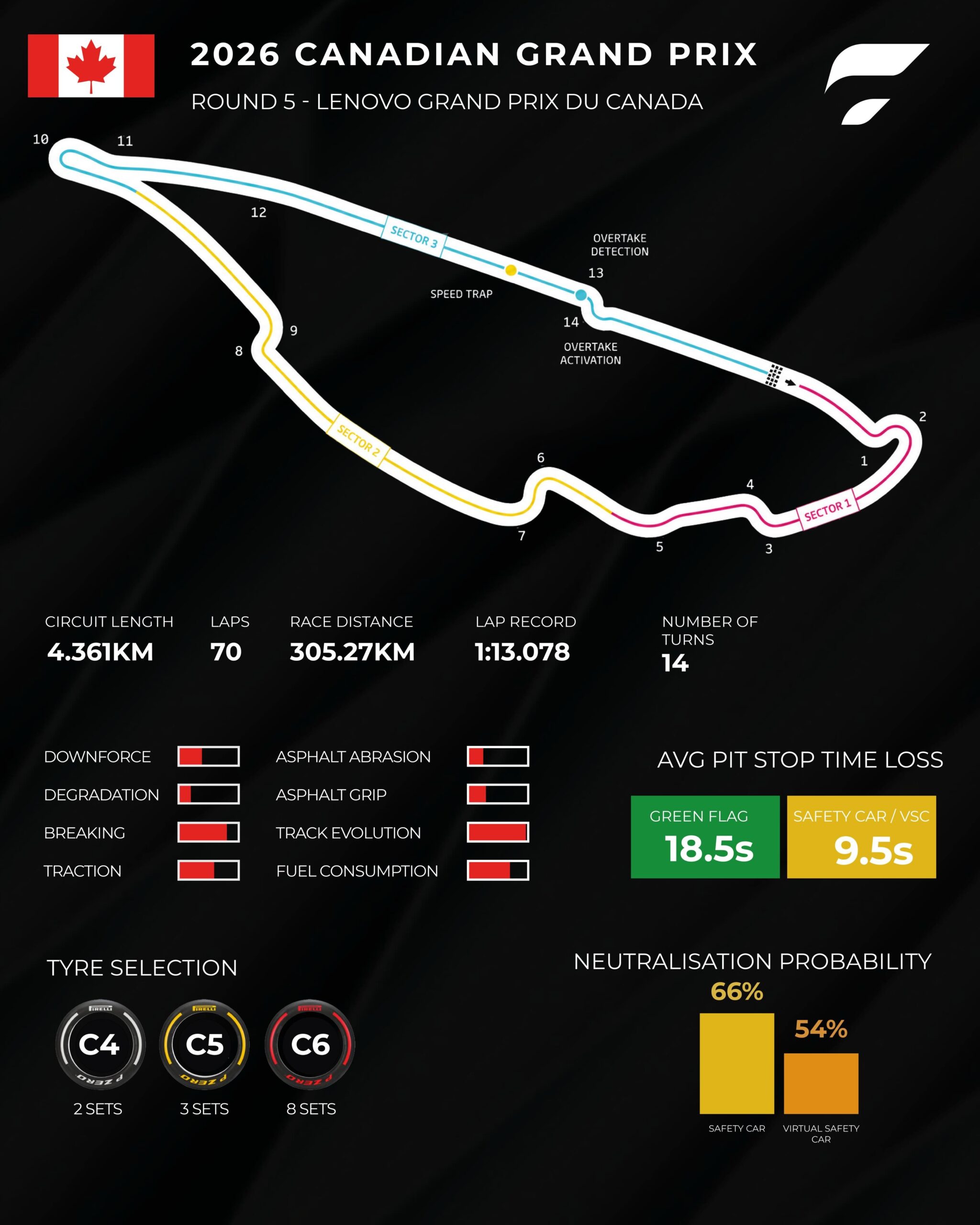
The circuit for the 2026 Canadian Grand Prix stretches over 4.361 kilometers, with competitors facing 70 laps to complete a total race distance of 305.27 kilometers. With 14 turns winding through three distinct sectors, the layout tests every aspect of car performance. Sector 1, highlighted in red, sets an early challenge, while the yellow-marked Sector 2 and blue-highlighted Sector 3 each bring their own unique demands.
Key secondary phrases such as “circuit length,” “number of turns,” and “lap record” are central to understanding what makes this venue so demanding. The lap record stands at a swift 1:13.078, underscoring the pace required to succeed here.
Tyre Selection, Pit Stop Strategies, and Neutralisation Probabilities
Tyre selection plays a pivotal role at the Canadian Grand Prix, with teams choosing between C4, C5, and C6 compounds. The allocation includes two sets of C4s, three sets of C5s, and eight sets of C6s—each influencing grip and durability on this evolving track surface. Asphalt grip and track evolution are crucial secondary phrases that shape how teams approach both qualifying and race day.
Strategic pit stops are another decisive factor. On average, a pit stop under green flag conditions costs 18.5 seconds, while under safety car or virtual safety car conditions, that time drops to just 9.5 seconds. This makes timing critical as teams respond to changing race circumstances.
The probability of neutralisation adds another layer of intrigue: there’s a 66% chance for a safety car appearance and a 54% chance for a virtual safety car period. These statistics highlight the unpredictable nature of racing at this circuit.
Technical Demands: Downforce, Braking, and Traction
The Canadian Grand Prix circuit is renowned for its technical challenges. High levels of downforce, braking demands, degradation, and traction requirements push both cars and drivers to their limits. Fuel consumption is also a significant factor as competitors balance speed with efficiency over the long race distance.
With its blend of high-speed straights, tight corners, and strategic complexity, the 2026 Canadian Grand Prix promises an unforgettable spectacle for fans and teams alike.